


Summary
In This Article
- 1. Why Collaboration Breaks Down for Remote and Distributed Professionals
- 2. What a Collaborative Workspace Actually Looks Like
- 3. Coworking Areas: Where Spontaneous Connection Happens
- 4. On-Demand Meeting Rooms: Collaboration on Your Terms
- 5. Team Offices: For Groups That Need to Work Together Daily
- 6. Work Simple's Denver Locations and What to Expect
Most professionals know what it feels like when collaboration is working: ideas flow freely, problems get solved in real time, and the work benefits from more than one perspective. What’s harder to put a finger on is why it stops working, and how much of that has to do with the working environment.
For remote workers, freelancers, and distributed teams in Denver, the answer is often that the spaces available to them simply weren’t designed with collaboration in mind.
Why Collaboration Breaks Down for Remote and Distributed Professionals
Working from home solves a lot of logistical problems, but it creates a specific collaboration problem: proximity.
The informal interactions that happen naturally in a shared space, like a question asked across a desk, a five-minute debrief after a call, or an impromptu whiteboard session, don’t have a clean remote equivalent. Video calls can substitute for scheduled meetings, but they’re a poor substitute for the kind of low-friction, in-person contact that moves work forward between meetings.
For solo professionals, the isolation is different but equally limiting. Freelancers, consultants, and independent contractors lose access to the ambient creative energy that comes from working near other people. There’s no one to bounce ideas off of, no organic sense of what other professionals in adjacent fields are working on, no casual networking that happens when people simply share a space.
Coffee shops are the default workaround for both groups, but they introduce their own friction: inconsistent Wi-Fi, no privacy for calls, limited control over noise, and nowhere to spread out when a project actually needs space.
They’re a good option occasionally, but they don’t foster and sustain great collaboration.
What a Collaborative Workspace Actually Looks Like
A well-designed collaborative workspace isn’t just an open floor plan with a few plants. It’s an environment with distinct zones that serve different types of interactions and work modes. There are areas designed for the kind of focused individual work that feeds into collaboration, common areas where casual interaction can happen organically, and private spaces where groups can work together without disrupting others or being disrupted themselves.
The design also accounts for the practical side of collaboration: reliable high-speed internet, audiovisual equipment in meeting rooms, whiteboards for working through problems visually, and enough space that groups can spread out when they need to.
None of this is extremely complicated, but it requires an intentional design that most home offices and coffee shops lack. On the other hand, a well-run, flexible workspace is designed with collaboration in mind.
Coworking Areas: Where Spontaneous Connection Happens
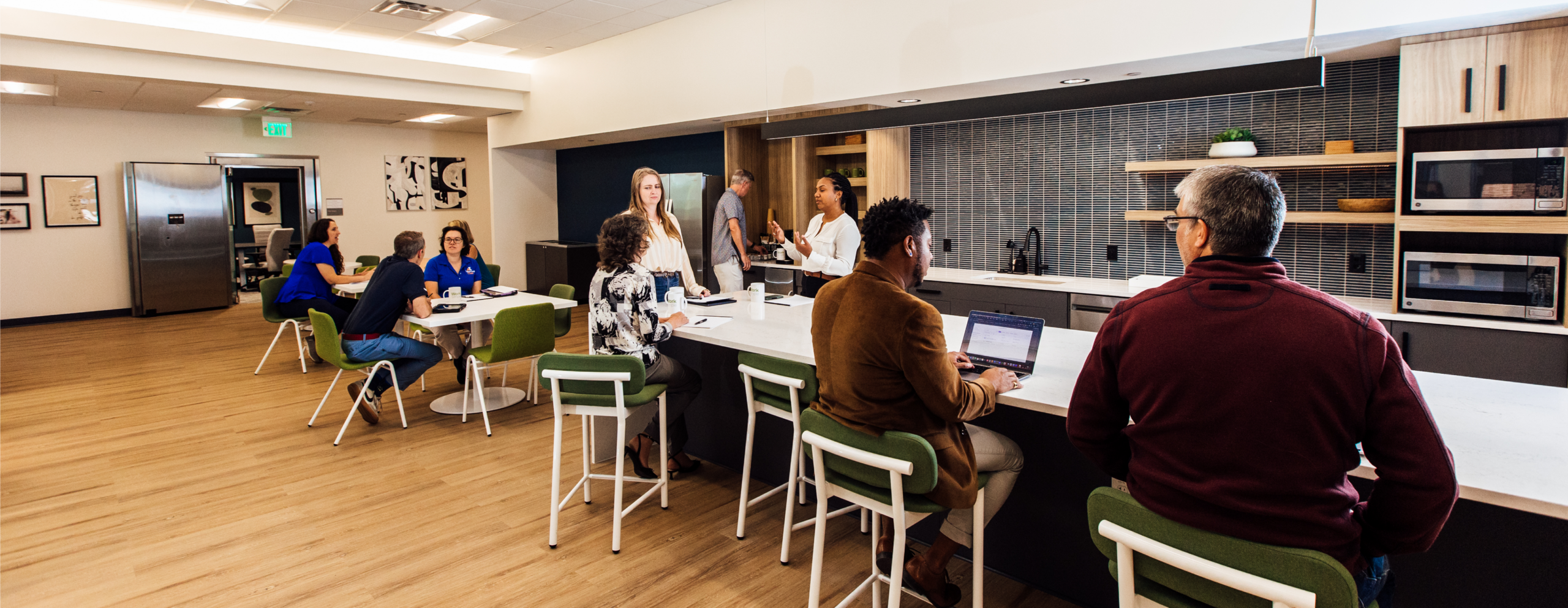
The coworking floor is where the ambient side of collaboration lives. It’s where professionals working on entirely different projects end up in a conversation that turns into a referral, a partnership, or just a useful outside perspective on a problem they’ve been stuck on.
This kind of connection can’t be scheduled, but it can be designed for.
Open coworking areas with comfortable seating, shared tables, and common spaces create the conditions for it. The environment signals that interaction is welcome without making it mandatory, which is the balance that makes a coworking floor useful for both independent work and spontaneous collaboration.
Work Simple’s flexible coworking memberships provide access to these shared areas, giving members a consistent professional space and the community that comes with it, without the overhead of a traditional office.
On-Demand Meeting Rooms: Collaboration on Your Terms
Not all collaboration is spontaneous. Presentations, project kickoffs, client reviews,and team check-ins need spaces designed for face-to-face conversations. On-demand meeting rooms give professionals and teams access to a fully equipped, private space when they need it, without paying for space they aren’t using.
The practical advantages are significant. A conference room with audiovisual equipment, a whiteboard, and seating for a group is a different environment than a video call or a huddle around a laptop. It gives everyone in the room a sense that the conversation is worth showing up for, and it removes the distractions and limitations that come with trying to collaborate in an open or informal setting.
Work Simple’s conference room rentals are available by the hour at both Colorado locations, with rooms that can accommodate small team meetings and larger group sessions. Coworking members and professional business address plan holders receive discounted rates. This gives teams the flexibility to book a room as soon as it’s needed, rather than defaulting to a video call or paying for meeting rooms that sit empty most of the time.
Team Offices: For Groups That Need to Work Together Daily
For small teams that need more than occasional access to shared space, a team office provides a dedicated environment where the full group works together on a consistent basis.
This matters for teams where the work itself benefits from proximity: creative teams that build on each other’s ideas in real time, client-facing teams that need to coordinate quickly, or early-stage businesses where the culture is still being built and in-person time has outsized value.
Work Simple’s team office solutions give groups a private, move-in-ready space without the long-term lease that traditional office arrangements require. Teams get the collaboration benefits of a shared office and the flexibility of a month-to-month agreement.
This is a meaningful alternative to working remotely for teams that are growing, but not yet ready to commit to a multi-year space. Now your workspace can scale with your team on your schedule, not your landlord’s.
Work Simple’s Denver Locations and What to Expect
You said: alt text for these 4 imagesWork Simple operates collaborative workspace in Denver at two Colorado locations: Westminster, near US-36 and Sheridan Boulevard, and Denver Tech Center in Greenwood Village. Both locations offer coworking memberships, on-demand conference and meeting rooms, private offices, and team office solutions under one roof. Plans include 24/7 access, free parking, and all-inclusive transparent pricing.
The setup is designed for professionals who need a range of workspace options as their needs shift, whether that’s a coworking desk on a Tuesday, a conference room for a Thursday client meeting, or a team office for a group that’s past the point of running everything remotely.
Frequently Asked Questions
What is a collaborative workspace?
How is a collaborative workspace different from a regular coworking space?
Can I book a meeting room at Work Simple without a coworking membership?
What size teams do Work Simple's team offices accommodate?
Is collaborative workspace in Denver available with month-to-month terms?
What's included in a coworking membership at Work Simple?


